
SATA SSD VS. NVME M.2 SSD: REAL-WORLD DATA TRANSFER PERFORMANCE FOR ENTERPRISE WORKLOADS
Category: Tech Insights & Infrastructure | Reading time: ~10 minutes | Level: All users
SATA SSD vs NVMe M.2 SSD: Enterprise Storage Performance Explained. Modern enterprises rely on fast, reliable storage to power databases, virtualization, and large‑scale media workflows. This article compares SATA SSD and NVMe M.2 SSD, highlighting protocol differences, bus pipelines, and benchmark results that directly impact workload efficiency. Learn to analyze communication protocols, optimize parallel data streams, and deploy high‑performance infrastructure, all while preventing server bottlenecks. By exploring real‑world deployment strategies, IT leaders can eliminate bottlenecks, maximize throughput, and future‑proof their infrastructure for next‑generation demands.
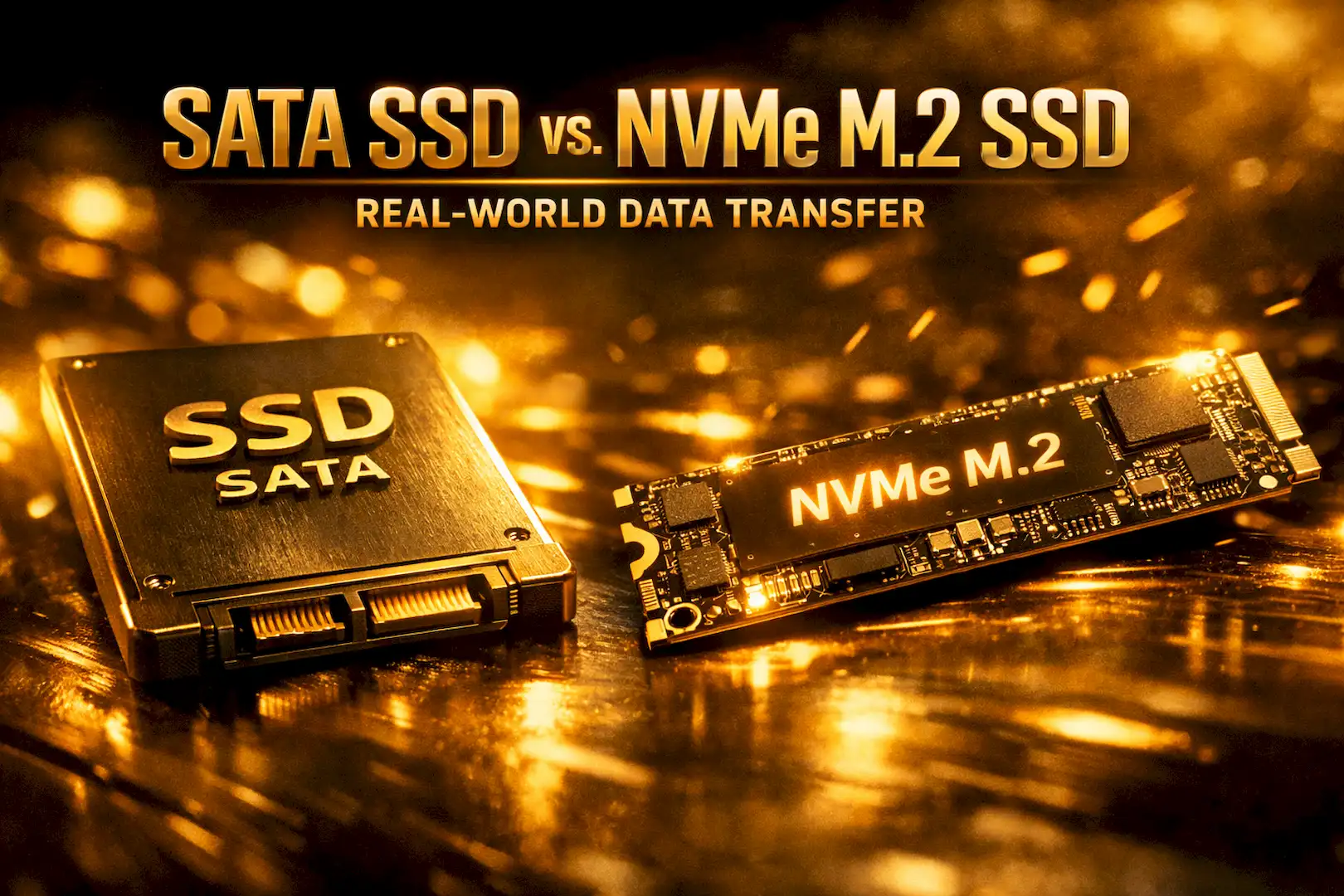
Many enterprise administrators and system engineers upgrade their storage systems expecting an instant speed boost, only to find their servers still choking under heavy database loads. Upgrading your storage infrastructure without understanding the deep technical gap between SATA and Non-Volatile Memory Express means wasting hardware budget on obsolete communication pathways. This guide changes that. By the end, you will understand the deep architectural differences between legacy and modern flash data protocols, how physical form factors can mislead buyers, and — most importantly — the specific workloads that require maximum input/output speeds to run fluidly.
FOCUS POINTS
- THE PROTOCOL CHOKE POINT: How legacy communication engines bottleneck high-speed solid-state flash memory chips.
- BUS PIPELINES AND FORM FACTORS: Dissecting physical connector dimensions from underlying motherboard routing lanes.
- ENTERPRISE HARDWARE BENCHMARKS: Analyzing sequential speeds and random execution command queues side by side.
- REAL-WORLD DEPLOYMENT STRATEGIES: Correctly matching hardware storage profiles to your specific business infrastructure.
1. THE PROTOCOL CHOKE POINT: UNDERSTANDING THE AHCI VS. NVMe DISCONNECT
Before spending money on high-capacity storage drives, you must analyze how those devices talk directly to your system processor. Running high-throughput applications on a legacy interface protocol results in immediate data stacking, command latency, and system processor idling.
- ANALYZE THE AHCI LEGACY ENGINE: Advanced Host Controller Interface was engineered around structural mechanics meant for spinning hard drives with moving read needles. It operates on a single processing highway that can handle only 1 queue containing up to 32 commands at a time.
- EXPLORE PARALLEL NVMe ARCHITECTURE: Non-Volatile Memory Express scales past legacy boundaries by talking directly to your processor core. The protocol supports up to 64,000 distinct queues, with each queue executing 64,000 commands simultaneously.
- TRACK LATENCY REDUCTIONS: Bypassing slow intermediary storage controllers cuts communication seek times in half, ensuring micro-transactions clear instantaneously.
2. BUS PIPELINES AND FORM FACTORS: SEPARATING INTERFACES FROM SHAPES
ELIMINATING THE PHYSICAL CONNECTOR CONFUSION
A massive point of failure for IT buyers is assuming that all modern, small-form-factor storage modules run at identical speeds. Mismatched slot configurations can result in a new storage device running at a fraction of its true performance potential.
- DECODE THE M.2 FORM FACTOR TRAP: The term M.2 refers entirely to the physical shape of the drive card—resembling a stick of chewing gum. An M.2 motherboard connection slot is just a physical housing and can be wired to run either slow SATA signals or blazing fast PCIe lanes.
- MAP THE SATA III CONTROLLER LIMITS: SATA III drives pass data through aging cables or restricted motherboard slots, maxing out at a absolute theoretical limit of 6 Gbps, which translates to roughly 550 MB/s of real-world usable read speed.
- OPEN THE PCIE EXPRESS LANE: NVMe M.2 modules plug straight into the motherboard’s scalable PCIe (Peripheral Component Interconnect Express) bus, utilizing up to 4 direct lanes to bypass all intermediate data checkpoints.
3. ENTERPRISE HARDWARE BENCHMARKS: STRUCTURAL SEVENTY-FOLD PERFORMANCE GAPS
EVALUATING RAW NUMERICAL METRICS FOR SERVER LOADS
When planning data server arrays or high-availability virtual networks, system administrators must evaluate precise data-transfer thresholds rather than relying on standard retail marketing claims. The underlying architectural gap between legacy SATA platforms and scalable PCIe Gen 4 NVMe hardware becomes undeniable when comparing raw technical metrics:
4. REAL-WORLD DEPLOYMENT STRATEGIES: MATCHING HARDWARE TO APPLICATION WORKLOADS
While standard daily tasks like writing text files or launching lightweight software look identical on both storage configurations, heavy enterprise software workloads draw a sharp line between these technologies.
- HIGH-DENSITY DATABASE MANAGEMENT: Enterprise relational systems (SQL or Oracle) execute thousands of transactions per second. SATA drives fill their tiny queues instantly, stalling traffic, while NVMe drives handle massive parallel write requests effortlessly.
- LOCAL VIRTUALIZATION AND HOMELABS: Running multiple Virtual Machines (VMs) via hypervisors like Proxmox or ESXi strains your storage system. Running over 3 high-load VMs on a single SATA drive creates severe disk delays, whereas NVMe IOPS headroom balances multiple virtual systems cleanly.
Sustained Media Production Pools: Moving massive 4K/8K data assets or assembling code compiles requires thick sequential pipelines. Transferring a 100 GB fileset takes minutes on a SATA drive, but finishes in seconds on a PCIe Gen 4 NVMe array.
5. SYSTEM REPURPOSING: SAVING COSTS WITH HYBRID STORAGE TOPOLOGIES
STRATEGIC PLACEMENT FOR LEGACY ASSETS
Do not discard older storage hardware completely; instead, allocate your budget symmetrically to achieve maximum cost-to-performance utility.
- DEPLOY SATA III ASSETS FOR: Upgrading legacy desktop units, setting up cold-storage offline archives, or building high-capacity arrays where cost-per-gigabyte is your priority metric. For steps on connecting multiple legacy units safely, reference our guide on how to use a SATA power splitter for dual SSDs.
- DEPLOY NVMe M.2 ASSETS FOR: Primary operating system boot allocations, processing high-traffic active databases, or structuring high-demand virtualization server arrays.
- VERIFY THROUGH COMMAND PROMPT: Track active system configurations by launching cmd, entering diskpart, and typing list disk to view and benchmark active hardware data routing.
THE FUTURE OF ENTERPRISE STORAGE PERFORMANCE
Choosing between SATA SSD and NVMe M.2 SSD isn’t just about raw speed — it’s about aligning your infrastructure with the right communication protocol for your workload. NVMe’s parallel architecture and PCIe lane efficiency deliver unmatched throughput for modern enterprise environments, while SATA remains a reliable choice for archival and cost‑efficient deployments. By understanding these architectural differences, IT leaders can eliminate latency bottleneck for next‑generation workloads.
At Saritsystech, we continue to decode complex hardware technologies into actionable insights for professionals who demand precision and performance. Bookmark our site and return often for more Tech Insights & Infrastructure — where innovation meets clarity. Help to share this post for others to benefit from the knowledge. Thank you for reading!
Good Post
Thanks!
I am in Izki. Are you in Izki too? Please respond!
It will be a pleasure if you can promote our products via your website here. I have sent you an email via your official email, info@saritsystech.com. Kindly check and respond to us. Thanks for your good work.
I have replied you via your email. Thanks
Good Post brother. Thanks a lot!
Thanks!
Nice bro!
Good job brother, I learned a lot about SSD from this post
I am happy you said this because this is the objective of this website.